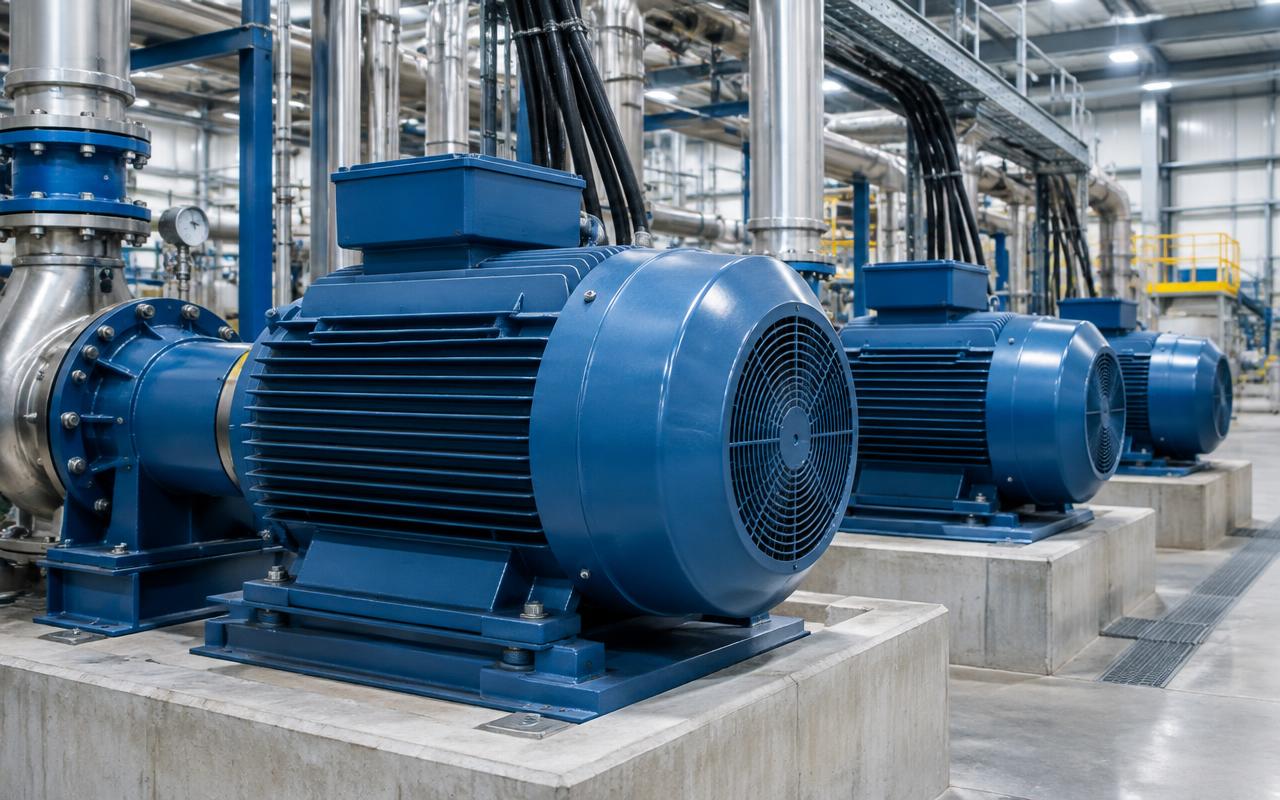
How a rotating field is created
Three stator windings spaced 120° apart, fed by three currents 120° apart in time, produce a magnetic field that rotates at synchronous speed: rpm = 120 × frequency ÷ poles. Every three-phase motor type uses this field. They differ in how the rotor follows it.
Squirrel-cage induction motors
The rotor is a set of conductive bars shorted by end rings. The rotating field induces currents in the bars, producing torque. The rotor always turns slightly slower than the field, a difference called slip, usually 1–5% at full load.
- Pros: rugged, low cost, little maintenance, widely available.
- Cons: high inrush (often 6–8× full-load current across the line), limited speed control without a VFD.
- Uses: pumps, fans, compressors, conveyors, nearly everything general-purpose.
Wound-rotor induction motors
The rotor has windings brought out through slip rings to external resistors. Adding resistance gives high starting torque with lower current, and allows some speed control.
- Pros: smooth high-torque starts for heavy-inertia loads.
- Cons: brushes and slip rings need maintenance. Often replaced today by squirrel-cage motors with VFDs.
- Uses: legacy cranes, hoists, crushers, mills.
Synchronous motors
The rotor locks onto the rotating field and turns at exactly synchronous speed. Large, DC-excited synchronous motors can run at leading power factor, helping to correct a plant's power factor.
- Pros: constant speed regardless of load, high efficiency, power factor control.
- Cons: higher cost and complexity; needs a starting method.
- Uses: large compressors, refiners, mills.
Permanent-magnet and reluctance motors
Permanent-magnet synchronous motors (PMSM) and synchronous reluctance motors usually run on a VFD. They reach very high efficiency, especially at part load, and are increasingly used in HVAC, pumping and compressors.
Comparison
| Type | Speed | Efficiency | Cost | Best for |
|---|---|---|---|---|
| Squirrel-cage induction | Slightly below synchronous | Good–very good | Low | General purpose |
| Wound-rotor induction | Adjustable via rotor resistance | Good | Medium–high | High-inertia starts (legacy) |
| Synchronous (DC excited) | Exactly synchronous | Very good | High | Large constant-speed drives, PF correction |
| Permanent-magnet | Synchronous, on VFD | Excellent | Medium–high | Variable-speed efficiency |
Ready to choose? Work through the Motor Selection Guide.