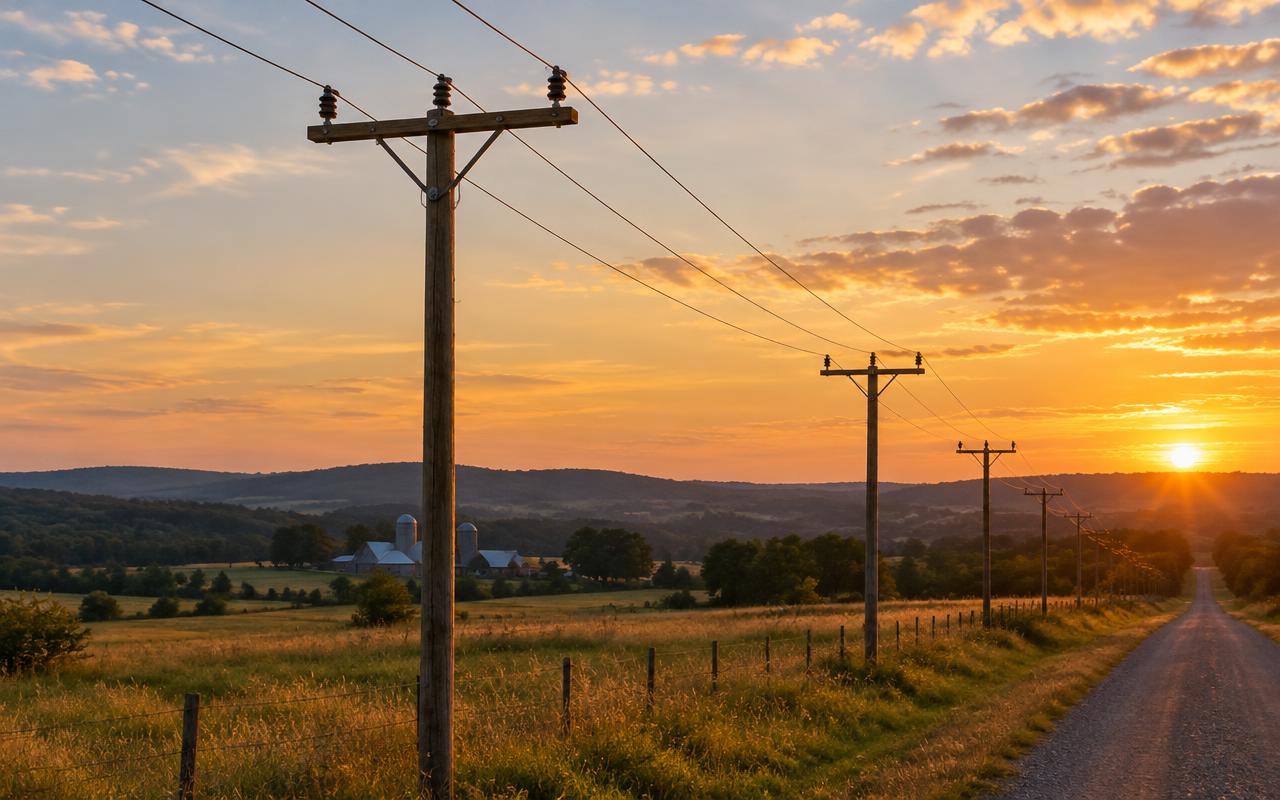
Overhead or underground?
| Overhead | Underground | |
|---|---|---|
| Cost | Lower initial cost | Typically several times higher |
| Reliability | Exposed to weather, trees, vehicles | Protected; faults harder to locate |
| Repair | Faster to find and fix | Excavation required |
| Aesthetics | Visible | Hidden; often required in developments |
Planning and design
- Route survey, easements/right-of-way and environmental considerations
- Load, voltage class (e.g., 12.47 kV, 13.2 kV, 24.9 kV) and future capacity
- Pole class and height from loading calculations for wind, ice and conductor tension
- Span lengths, guying and anchoring at angles and dead-ends
- Clearances to ground, roads, buildings and other circuits per NESC
Poles and framing
Three-phase distribution is commonly framed with a crossarm carrying three phase conductors and the neutral below. Compact designs use armless or vertical construction. Wood poles are graded by class (ANSI O5.1). Steel, concrete and composite poles are alternatives in corrosive or high-loading areas.
Conductor selection
- ACSR (aluminum conductor steel reinforced): strong, common on long spans.
- AAC / AAAC: all-aluminum or aluminum-alloy conductors for shorter spans or corrosive areas.
- Spacer cable / tree wire: covered conductors where vegetation contact is likely.
- Size for ampacity, voltage drop, fault duty and mechanical loading. Sag and tension tables are used at stringing.
Construction sequence
- Staking and locates (call 811 before digging)
- Setting poles and installing guys and anchors
- Framing: crossarms, insulators and hardware
- Stringing and sagging conductors to design tension
- Installing transformers, cutouts, arresters and grounding
- Inspection, testing and energization coordinated with the utility
Safety
Planning a private line? We can help you find design support and qualified line contractors via our Services.