Step 1: Define the load
- Load type: variable torque (centrifugal fans and pumps), constant torque (conveyors, positive-displacement pumps) or constant horsepower (some machine tools).
- Duty cycle: continuous, intermittent or frequent starts (NEMA ratings assume limits on starts per hour).
- Starting requirements: breakaway torque, inertia (WK²) and acceptable acceleration time.
Step 2: Horsepower and service factor
Pick the horsepower that covers the maximum continuous load. Gross oversizing lowers efficiency and power factor at light load. Service factor (often 1.15 on open motors) is a margin for short-term overload, not a planned operating point.
hp ≈ (torque lb-ft × rpm) ÷ 5,252
Step 3: Speed and poles
| Poles | Synchronous rpm | Typical full-load rpm |
|---|---|---|
| 2 | 3,600 | ~3,450–3,550 |
| 4 | 1,800 | ~1,725–1,780 |
| 6 | 1,200 | ~1,140–1,180 |
| 8 | 900 | ~860–880 |
Four-pole (1,800 rpm) motors are the most common and widely stocked. For variable speed, pair the motor with a VFD.
Step 4: Voltage
Match motor nameplate voltage to utilization voltage. Motors are rated 200 V on 208 V systems, 230 V on 240 V systems and 460 V on 480 V systems, which allows for voltage drop. Dual-voltage 230/460 V motors are common. NEMA MG 1 expects operation within ±10% of rated voltage.
Step 5: NEMA design letter
| Design | Starting torque | Starting current | Typical applications |
|---|---|---|---|
| A | Normal | Higher than B | Special applications needing high breakdown torque |
| B | Normal | Normal | Fans, pumps, blowers — most general purpose |
| C | High | Normal | Loaded conveyors, compressors, crushers |
| D | Very high, high slip | Low | Punch presses, hoists, high-inertia loads |
Step 6: Enclosure
- ODP (open drip-proof): clean, dry indoor locations.
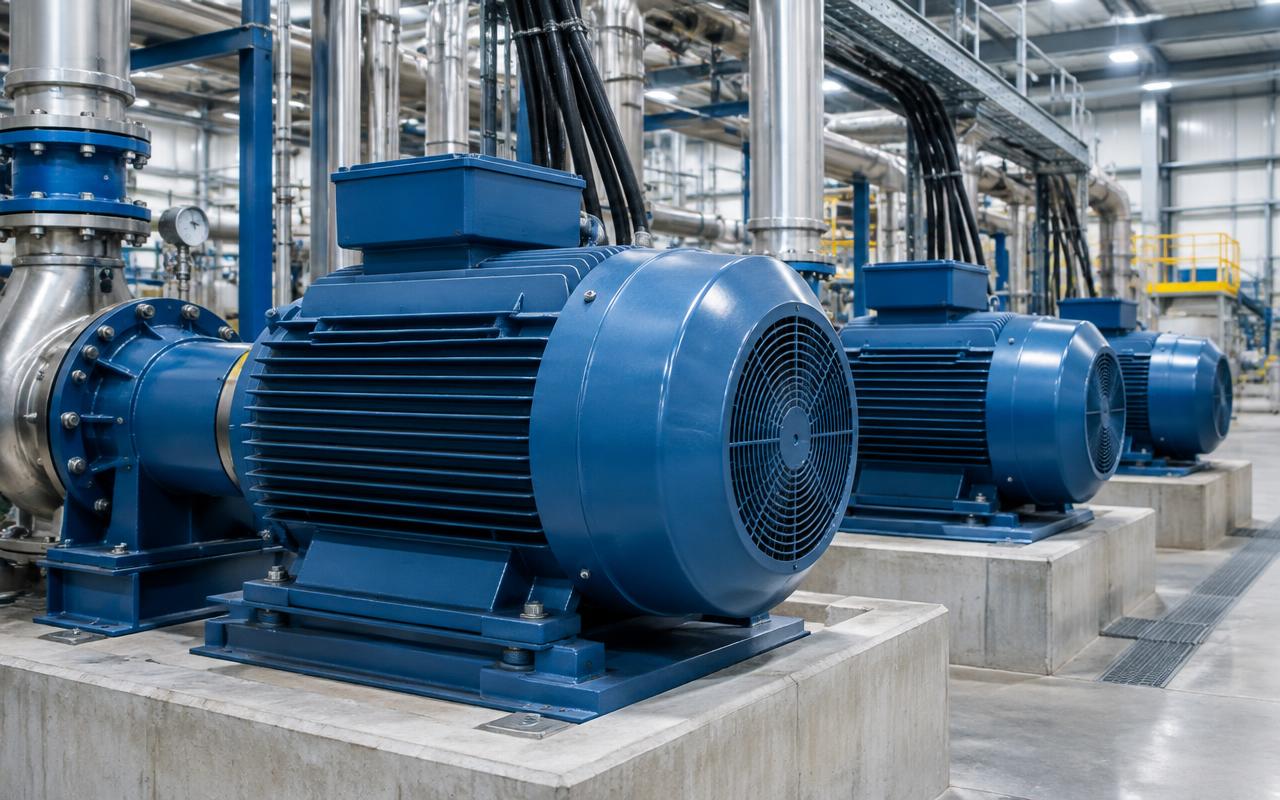
- TEFC (totally enclosed fan-cooled): dusty, damp or outdoor locations. The most common industrial choice.
- TENV / TEAO: no external fan. TEAO relies on the airstream of the driven fan.
- Explosion-proof / hazardous location: must be listed for the specific Class, Division or Zone and group.
- Washdown: food and beverage plants, with stainless or specially coated frames.
Step 7: Efficiency
Most general-purpose motors sold in the US must meet DOE minimum efficiency levels, broadly aligned with NEMA Premium. Lifetime energy cost usually dwarfs purchase price, so compare nameplate efficiency at your expected load.
Step 8: Mounting, frame and accessories
- NEMA frame size (e.g., 256T) fixes shaft height and mounting dimensions. Match it when replacing.
- Mounting: foot (F1/F2), C-face or D-flange.
- Inverter-duty insulation (NEMA MG 1 Part 31) and shaft grounding for VFD use.
- Space heaters, thermostats or RTDs for condensation or thermal protection.